

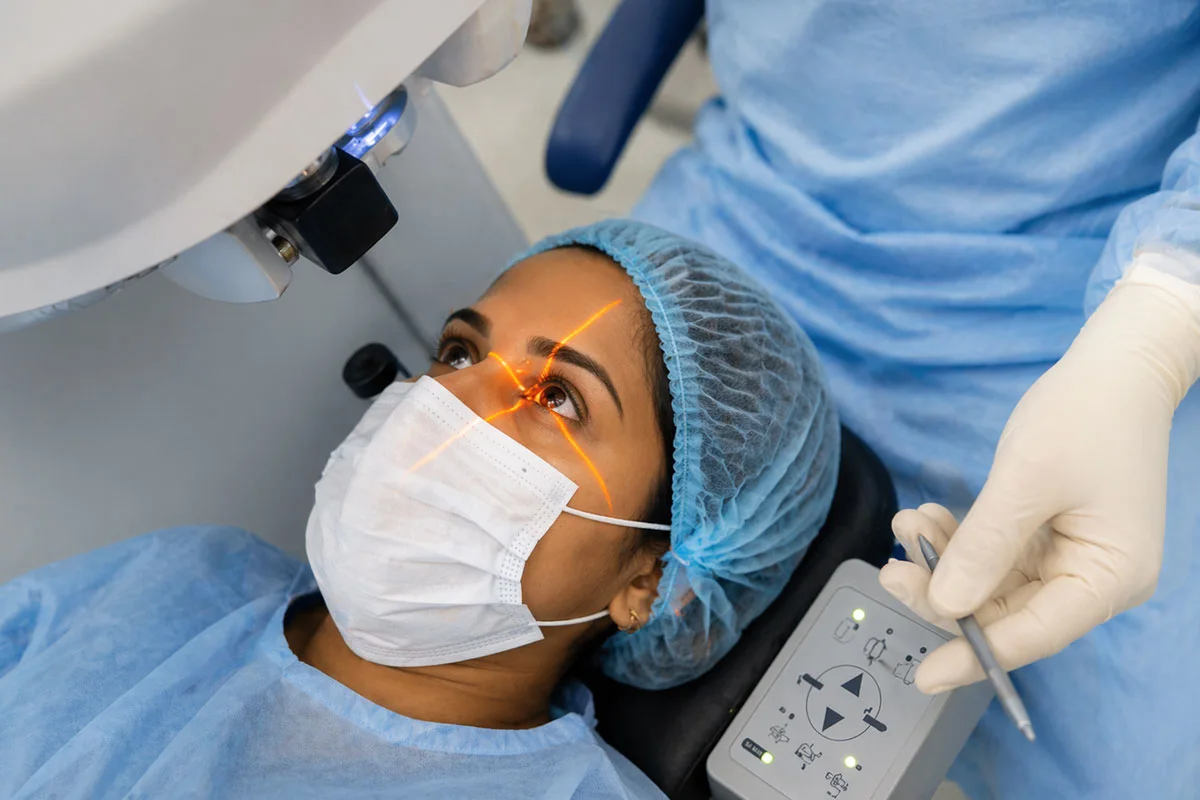
LASIK surgery (Laser-Assisted In Situ Keratomileusis) is one of the most advanced and popular procedures used to correct vision problems such as myopia (short sight), hyperopia (long sight), and astigmatism. This modern laser eye surgery helps reduce or eliminate the need for glasses and contact lenses by reshaping the cornea so that light focuses correctly on the retina.
At our Eye Hospital in Banashankari, we provide advanced LASIK eye surgery in Bangalore using modern laser technology and expert care to help patients achieve clearer and sharper vision safely.
Many people choose LASIK because it is:
If you are planning to undergo LASIK surgery in Banashankari, understanding the treatment, benefits, recovery, and possible side effects can help you make a confident decision.
LASIK surgery is commonly recommended for people with refractive vision problems.
Nearsightedness (Myopia)
People with myopia can see nearby objects clearly but struggle to see distant objects. LASIK reshapes the cornea to improve distance vision and reduce dependency on glasses.
Farsightedness (Hyperopia)
Hyperopia makes it difficult to focus on close objects. Laser eye surgery adjusts the corneal shape to improve near vision clarity.
Astigmatism
Astigmatism occurs when the cornea has an irregular shape, causing blurred or distorted vision. LASIK surgery smooths the corneal surface to provide clearer and sharper vision.
Proper preparation is important for successful LASIK eye treatment.
Before surgery, patients are usually advised to:
At our LASIK Eye Hospital in Banashankari, our specialists carefully evaluate your eyes to ensure the treatment is safe and suitable for you.
The LASIK procedure is simple, safe, and usually completed within 20–30 minutes.
Step-by-Step LASIK Procedure:
Most patients begin noticing clearer vision within a few hours after surgery.
Like any medical procedure, LASIK surgery may have some temporary side effects, although most patients recover comfortably.
Dry Eyes
Mild dryness is common after surgery. Eye drops prescribed by the doctor usually help reduce discomfort.
Glare and Halos
Some patients may notice glare or halos around lights, especially at night. These effects are usually temporary and improve over time.
Fluctuating Vision
Vision may appear slightly unstable for a few days or weeks before completely settling.
Our experienced LASIK specialists in Banashankari monitor recovery closely to ensure proper healing and comfort.
Although LASIK is highly effective, it may not be suitable for everyone.
LASIK may not be recommended for:
A detailed eye evaluation helps determine whether LASIK is the right option for you.
Recovery after LASIK surgery is usually very quick compared to other procedures.
What to Expect After Surgery:
First 24 Hours
Within 1 Week
After 1 Month
Within 3–6 Months
Following post-surgery care instructions properly helps ensure smooth recovery and better outcomes.
LASIK surgery is generally considered very safe, but like any procedure, there are some possible risks.
These may include:
At our Eye Hospital in Banashankari, advanced technology and experienced surgeons help minimize risks and ensure safe treatment.
Book your consultation today at our trusted Eye Hospital in Banashankari and take the first step toward a life with reduced dependency on glasses and contact lenses.
Below are some commonly asked questions about laser eye surgery, vision correction treatment, recovery, and LASIK results.
LASIK eye surgery provides long-lasting vision correction for most patients. The changes made to the cornea during the procedure are permanent.
However, natural age-related vision changes can still occur over time. Most people continue to enjoy clear vision for many years after treatment without depending on glasses or contact lenses.
At our LASIK Eye Hospital in Banashankari, we carefully evaluate each patient to ensure the best possible long-term results.
Although LASIK is a safe and effective treatment, it may not be suitable for everyone.
LASIK may not be recommended for:
Our experienced LASIK specialists in Banashankari perform detailed eye examinations to determine whether laser vision correction is safe and suitable for you.
Before the procedure, a detailed eye evaluation is performed to assess:
This pre-surgery assessment helps the doctor decide whether you are a good candidate for laser eye surgery in Bangalore.
Patients are also guided about precautions, medication, and what to expect during and after the treatment.
Recovery after LASIK is usually fast, but complete healing can take a few months.
Recovery Timeline:
During recovery, regular follow-up visits are important to monitor healing and maintain healthy vision.
At our Eye Hospital in Banashankari, we provide complete post-LASIK care and guidance for smooth recovery.
Mild blurry vision after LASIK is common during the healing phase.
This usually happens because:
Doctors generally recommend:
In most cases, vision gradually becomes clearer over the following weeks.
Right after LASIK surgery, some patients may experience:
These symptoms are usually temporary and improve within a short time.
Our experienced LASIK doctors in Banashankari may prescribe medications or eye drops to keep you comfortable during recovery.
During LASIK treatment, special numbing eye drops are used to reduce blinking and discomfort.
A small medical device may also be used gently to keep the eyes open safely during the procedure.
The surgery is quick, comfortable, and carefully monitored throughout.
LASIK surgery is generally not painful.
Before the procedure begins, numbing eye drops are applied to both eyes to prevent pain. Some patients may feel mild pressure during surgery, but there is usually no significant discomfort.
Most people are surprised by how quick and comfortable the procedure feels.
LASIK surgery is designed to correct refractive errors like:
However, LASIK does not remove cataracts or treat blurred vision caused by cataracts.
For cataract-related vision problems, patients may require cataract surgery in Banashankari instead.
Our eye specialists will recommend the right treatment after examining your eyes.
Yes, LASIK can help improve blurry vision caused by refractive errors.
Many people experience blurry vision due to:
With advanced laser eye treatment in Banashankari, LASIK reshapes the cornea to improve focus and provide clearer vision.
The cost of LASIK surgery depends on several factors, including:
In general, LASIK surgery cost in Bangalore may range from approximately ₹25,000 to ₹1,00,000 depending on the treatment plan.
At our Eye Hospital in Banashankari, we offer advanced LASIK treatment with personalized consultation and transparent pricing.
Refractive surgery is an advanced vision correction procedure designed to reduce or eliminate the need for glasses and contact lenses. It helps correct common vision problems such as:
At Advaith Eye Hospital in Banashankari, we offer advanced refractive eye surgery in Bangalore using modern laser technology and expert eye care to help patients achieve clearer and sharper vision.
Refractive surgery works by reshaping the cornea or replacing the eye’s natural lens so that light focuses correctly on the retina. This improves vision and helps patients enjoy daily life with greater comfort and confidence.
If you are tired of depending on glasses or contact lenses, refractive surgery may be a life-changing solution for you.
Refractive surgery improves vision by changing the way light enters and focuses inside the eye.
Different treatment methods are available depending on:
Modern laser vision correction procedures use advanced technology to provide:
Our experienced eye specialists carefully evaluate your eyes to recommend the most suitable refractive surgery option for you.
Not everyone may be suitable for refractive surgery. Ideal candidates generally include people who:
If you meet these conditions and want freedom from glasses, our refractive surgery specialists in Banashankari can help determine the right treatment for you.
Different types of refractive surgeries are available based on individual eye conditions and vision correction needs.
PRK is one of the earliest and most effective laser eye correction procedures.
In this treatment:
Benefits of PRK:
Although recovery may take slightly longer than LASIK, PRK remains a trusted option for many patients.
LASIK is one of the most popular and widely performed refractive surgeries.
During LASIK:
Benefits of LASIK Surgery:
At our LASIK Eye Hospital in Banashankari, we use advanced technology for safe and accurate treatment.
SMILE (Small Incision Lenticule Extraction) and FLEX are modern minimally invasive laser procedures.
In this treatment:
Benefits:
SMILE is ideal for patients looking for a flapless laser vision correction procedure.
For some patients, laser surgery may not be suitable. In such cases, lens-based procedures provide excellent alternatives.
ICL surgery involves placing a special lens inside the eye without removing the natural lens.
ICL is suitable for:
Benefits of ICL:
ICL is becoming a popular alternative to LASIK for eligible patients.
RLE replaces the eye’s natural lens with an artificial intraocular lens (IOL).
Best suited for:
This procedure improves vision while also reducing future cataract risk.
Advantages:
Many patients experience greater freedom and confidence after surgery.
Although refractive surgery is generally safe, some temporary side effects and risks may occur.
Possible Risks:
Our experienced eye specialists in Banashankari carefully evaluate each patient to minimize risks and ensure safe treatment.
Proper aftercare is important for smooth healing and the best visual outcomes.
Recovery Tips:
Most patients notice significant improvement in vision within a few days.
The cost of refractive surgery depends on type of procedure, Technology used, Eye condition & Surgeon expertise
Approximate Treatment Cost:
Refractive eye surgery is an advanced vision correction treatment that helps reduce or eliminate the need for glasses and contact lenses. It works by reshaping the cornea or replacing the eye’s natural lens so that light focuses correctly on the retina. Refractive surgery is commonly used to treat myopia (nearsightedness), hyperopia (farsightedness), astigmatism, and presbyopia.
At our Eye Hospital in Banashankari, we offer advanced procedures such as LASIK Surgery, PRK Surgery, SMILE Laser Surgery, Implantable Collamer Lens (ICL), and Refractive Lens Exchange (RLE) to help patients achieve clearer vision and improve their quality of life.
People who meet the following conditions are usually considered good candidates for refractive surgery:
Before recommending surgery, our experienced refractive surgery specialists in Banashankari perform a complete eye examination to ensure the treatment is safe and suitable for your eyes.
There are several types of refractive surgeries available depending on the patient’s eye condition and vision needs.
LASIK Surgery is one of the most popular laser eye correction procedures where a thin corneal flap is created and reshaped using a laser for quick vision improvement and faster recovery.
PRK Surgery is a flap-free laser procedure where the outer layer of the cornea is removed before reshaping the cornea using laser technology. It is commonly recommended for patients with thin corneas.
SMILE Surgery (Small Incision Lenticule Extraction) is a minimally invasive laser treatment where a small tissue layer is removed through a tiny incision. It offers faster healing, less discomfort, and lower dry eye risk.
ICL Surgery (Implantable Collamer Lens) is ideal for patients with high eye power or thin corneas. In this procedure, a special lens is implanted inside the eye without removing the natural lens.
Refractive Lens Exchange (RLE) replaces the natural eye lens with an artificial intraocular lens (IOL) and is often recommended for older adults with presbyopia or high hyperopia.
Refractive surgery is usually a quick and comfortable procedure that takes approximately 10 to 20 minutes per eye. The actual laser treatment in procedures like LASIK and SMILE only takes a few seconds.
However, patients may spend a few hours at the hospital for pre-surgery evaluation, preparation, and post-procedure observation. Modern laser technology ensures accurate, safe, and effective vision correction with minimal discomfort.
Refractive surgery is generally not painful because numbing eye drops are used before the procedure to prevent discomfort. During the surgery, patients may feel mild pressure or a slight sensation, but there is usually no pain.
After surgery, some patients may experience temporary irritation, dryness, watering, or mild discomfort, especially after PRK surgery. These symptoms usually improve within a few days with prescribed medications and proper eye care.
Recovery time depends on the type of refractive surgery performed.
After LASIK Surgery, most patients notice significant vision improvement within 24 to 48 hours, although minor fluctuations may continue for a few weeks.
PRK Surgery usually takes slightly longer to heal, with initial recovery taking around 3 to 5 days and complete visual clarity improving gradually over several weeks.
SMILE Surgery offers relatively faster healing, and vision often stabilizes within a few days to one week.
Patients undergoing ICL Surgery generally experience clearer vision within a few days because the cornea is not reshaped during the procedure.
For smooth recovery and the best vision results, patients should follow all post-surgery instructions, use prescribed eye drops regularly, avoid rubbing the eyes, and attend scheduled follow-up checkups with the eye specialist.